
 E-Paper



Shinde rebellion ends Uddhav’s plan to turn Sena into an inclusive party
To survive this existential crisis that besets the Shiv Sena, father and son have to give up any plans for a transformation of voter base, and tread the beaten path.


In 2003, Uddhav Thackeray, who had just been anointed working president of the Shiv Sena, launched an ambitious plan to expand his party. He reached out to Buddhist Dalits, especially those who supported the various factions of the Republican Party of India (RPI), at a ceremony to unveil the portrait of his grandfather and social reformer ‘Prabodhankar’ Keshav Sitaram Thackeray at Mumbai University. Prabodhankar Thackeray was among the doyens of the non-Brahmin movement in Maharashtra and an associate of anti-caste icons like Chhatrapati Shahu of Kolhapur.
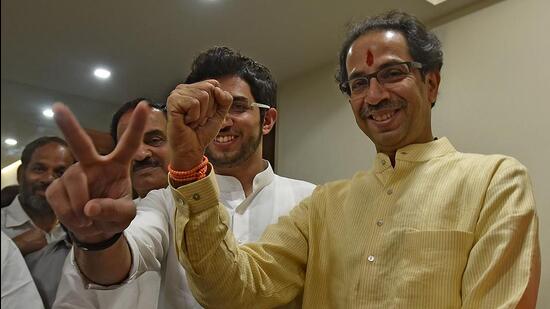
This ‘Shivshakti-Bhimshakti’ initiative was noteworthy as the Shiv Sena shared a bristly relationship with Buddhist Dalits, as the Hindu Dalits in the party were often at odds with them as they resented the dominance of the Buddhists over the larger Dalit movement. They were also seen as the only social force capable of standing up to the Sena on the streets of Mumbai. Not surprisingly, Uddhav’s ‘Shivshakti-Bhimshakti’ move had limited success though leaders of the Dalit Panthers movement like the avant garde poet Namdeo Dhasal joined hands with the party. The same year Uddhavalso launched another campaign, Mee Mumbaikar, to reach out to voters from other linguistic denominations, especially the Hindi-speaking migrants in Mumbai and neighbouring areas, and to create a constituency for the Sena beyond its core Marathi-speaking voter base.
But the ‘Mee Mumbaikar’ was tightrope walk from the word go. It aimed at creating a constituency among the Hindi-speakers and north Indians who competed with Maharashtrians for access to jobs, resources and opportunities in the burgeoning informal sector. But given the shrinking number of Maharashtrians in the city, Uddhav felt the party needed to expand its footprint in non-Maharashtrian households too. The campaign was aimed at ensuring that the ‘majority of the minority’, (north Indians, Muslims and Buddhist Dalits who were inimical to it) did not vote tactically to defeat the Sena. The soft-spoken Uddhav seemed the man who could soften the Sena’s rough edges and ‘secularise’ its strident Hindutva politics.
But the ‘Mee Mumbaikar’ campaign upset a section of hardliners in the Shiv Sena, including Uddhav’s estranged cousin Raj. In November 2003, activists from Raj’s Bharatiya Vidyarthi Sena (BVS) attacked job aspirants from north India who had come to Kalyan for the Railway recruitment exams. It has been a long-standing complaint of the Sena that these recruitment processes are biased in favour of candidates from Hindi-speaking states.
The Kalyan attack led to a massive consolidation by the north Indians in the 2004 assembly elections. Veteran leaders from the north Indian community admit that had Raj not spoiled the plot for the Sena, the Shiv Sena-BJP would have come to power in the state instead of the Congress and the Nationalist Congress Party (NCP).
In 2022, almost 20 years later, Aaditya Thackeray faces a similar challenge. Like his father was, two-decades ago, Aaditya is seen as the man who can expand the Shiv Sena beyond its core constituency through deft social engineering—by reaching out to cosmopolitan voters and taking the party beyond the ‘Marathi manoos’ agenda to pursue a politics centred around issues like environment. In 2019, when Aaditya decided to contest from Worli, posters in Gujarati asking, ‘Kem Cho Worli’ were put up in the constituency, followed by other multilingual campaign material.
Aaditya also appeared in south Indian attire—lungi and angavastram--during his campaign with an eye on the south Indian vote. Worli has pockets of Telugu speakers who came to Mumbai to work as textile mill hands, became contractors and labourers who built some of the city’s iconic buildings like Rajabai Tower, supported Mahatma Phule’s ‘Satyashodhak Samaj’ and also participated in the ‘Samyukta Maharashtra’ movement, identifying themselves as Marathis by conviction. It was obvious that the Sena, which, soon after its creation in 1966, had given the ‘Bajao pungi, Hatao Lungi’ slogan targeting south Indians, had moved on along with the rest of the city.
Notably, in 1951, Pandit Bhagirath Jha of the Socialist Party, the first north Indian MLA in the erstwhile Bombay legislative assembly, was elected from the Chinchpokli-Lower Parel-Love Grove constituency, which includes part of Aaditya’s Worli seat.
As the minister for environment in the Maharashtra Vikas Aghadi (MVA) government, Aaditya pushed issues like climate change, emission reduction and e-vehicles to centre stage, addressing the concerns of a younger demographic. What it also meant was that Aaditya and Uddhav were trying, once again, to take the party beyond its mono-cultural and mono-linguistic agenda and tap into a small yet growing caste and language neutral constituency in the urban and peri-urban youth.
However, Eknath Shinde’s rebellion has now forced Uddhav to abandon any semblance of inclusive politics. The party, if at all it wants to remain relevant, will have to go back to the core Marathi voter base and once again champion the cause of the Marathi manoos aggressively even as BJP and Shinde talk Hindutva politics.
Marathi-speakers, who form the mainstay of Shiv Sena’s supporters, fear being marginalised further in Mumbai and see the party as their alter ego. The BJP, despite its horizontal and vertical expansion, continues to be perceived as a party dominated by non-Maharashtrians and Mumbai’s mercantile class whose interests are essentially at odds with those of the Marathi working class and middle class. Hence, as veteran Shiv Sainiks boast, the Sena’s core voter consolidates behind it every time it is claimed that the party is on its death bed, thus giving it a new lease of life.
A cornered Uddhav may also revive the pitch about the plans to split Mumbai from Maharashtra to galvanise its voters, with Shinde’s political indebtedness to the BJP top brass in Delhi providing him a handy tool. That the BJP’s top bosses hail from neighbouring Gujarat, which had laid claim on Mumbai, albeit unsuccessfully, when the bilingual Bombay state was split to form Maharashtra and Gujarat in 1960, may provide more grist to the mill. After all, in 1985, when the Shiv Sena was at a low ebb, it was then chief minister and veteran Congressman Vasantdada Patil who provided it political ballast by claiming that there could be plans to split Mumbai from Maharashtra and the need to oppose it. Patil had a running battle with the then Mumbai Congress boss Murli Deora. This statement was used by the Sena to build up frenzy among the Marathi speakers in Mumbai, who feared being marginalized further. The party swept the Brihanmumbai Municipal Corporation (BMC) polls that year, something that was to keep it relevant for decades to come.
Today, the Shiv Sena faces the near-impossible task of retaining power in the BMC, India’s richest civic body. The BMC was controlled by the Sena between 1985-1992 and then again from 1997 until now. Any loss of power in Mumbai will hit the Sena hard as many of its full-time workers survive on the spoils that trickle down through the power networks in the civic body. This ‘reward economy’ helps keep its party organisation in fine fettle.
The urbane, suave Aaditya is seen as a woke—he spells his full name as Aaditya Rashmi Uddhav Thackeray. He is perceived as someone who keeps company with the kind of people who do not fit into the mould of an archetypal Shiv Sainik—a former BVS hand complains that the demeanour and lifestyle of some senior leaders of the Yuva Sena makes one feel that they even iron their shoes. Like his father, Aaditya has been blamed for being inaccessible and surrounding himself with a cabal, most members of which form part of the social and economic elite with little in common with the average Sainik who stays in chawls or lower-income group housing. The other charge that sticks is his gradual estrangement from the essential Marathi cause.
To simply survive this existential crisis that besets the Shiv Sena, father and son have to give up any plans for a transformation of voter base, and tread the beaten path by addressing the existential anxieties of the sons-of-soil who still feel discriminated against on social, economic and cultural grounds.
However, this return to its basics may lead the Shiv Sena to abandon its agenda of Hindutva, which was always incongruent with its Marathi agenda. Embracing Hindutva in the late 1980s to confirm to the rising majoritarian consolidation nationwide, meant that the Sena, a nativist party, had to turn a blind eye to cultural assertion by non-Marathi speakers like the Gujaratis, Marwaris and north Indians, even while the Maharashtrians felt marginalized. With Prime Minister Narendra Modi seen as the present-day ‘Hindu Hridaysamrat,’ the Sena risks coming across as a poor imitator if it pushes this agenda.
The Shiv Sena’s growth as a pan-Maharashtra regional force unlike the regional parties down south has been prevented by Hindutva as it alienates sections like Marathi Muslims and Buddhist Dalits. A logical extension of the Marathi manoos agenda would be to take on the mantle of regional pride if not the blatant sub-nationalist political discourse pursued by these southern political formations, highlight the disparities in development that leads to Maharashtra facing the burden of migrants from other states and the need for the state to get a larger share of the central pie and devolution of resources considering its status as an industrial and economic power-house. It may not seem so, but an opportunity could be crouching in the deep shadows that Uddhav Thackeray finds himself in.
Stay updated with all the Breaking News and Latest News from Mumbai. Click here for comprehensive coverage of top Cities including Bengaluru, Delhi, Hyderabad, and more across India along with Stay informed on the latest happenings in World News.


